
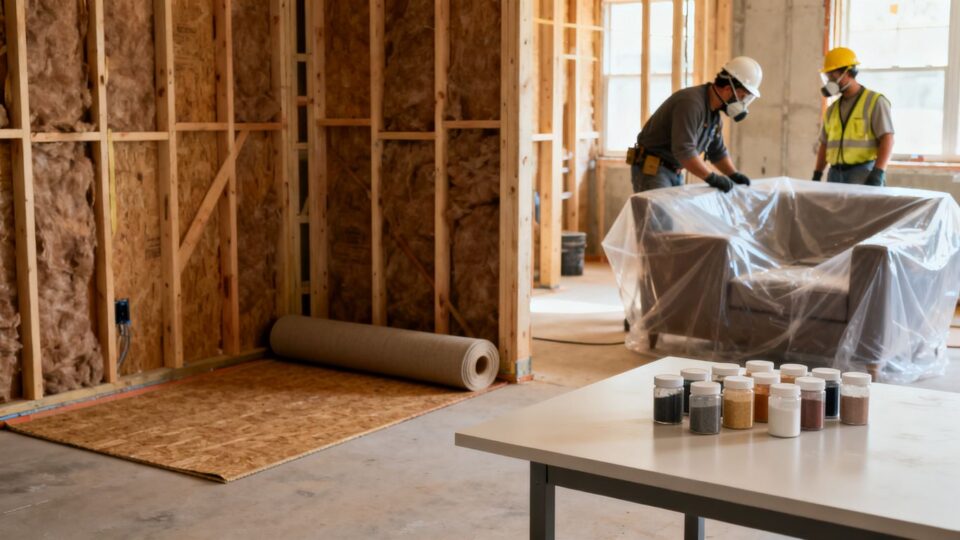
A pre-renovation asbestos inspection is designed around the work that will disturb a building, not simply around what can be seen during a casual walk-through. The inspector considers the property’s age, construction history, planned demolition, and materials that may be hidden behind finishes. The goal is to identify suspect materials before workers cut, sand, drill, remove, or otherwise disturb them.
Materials and building areas inspectors typically evaluate
Inspectors commonly review flooring and adhesives, ceiling tiles, textured coatings, drywall compounds, insulation, pipe wrap, duct materials, roofing products, siding, and other components that may be affected by the remodeling plan. They also look at basements, mechanical rooms, attics, wall cavities, and exterior areas when those spaces fall within the project scope. A basement pipe inspection can be especially relevant when an older home’s heating or plumbing systems are scheduled for alteration.
The inspection should follow the renovation drawings or contractor’s scope as closely as possible. A material outside the planned work area may not require sampling immediately, while a seemingly minor product beneath a floor or inside a wall may deserve close attention if demolition will expose it.
When visual inspection is not enough
Asbestos fibers cannot be confirmed by appearance alone. Some suspect materials look ordinary, and visually similar products may contain very different compositions. A professional must determine whether sampling is appropriate rather than relying on color, texture, or a product’s age as proof.
That distinction matters because disturbing a material merely to examine it can create the very exposure the inspection is meant to prevent. Until test results are available, workers should avoid treating an untested suspect material as harmless.
How sampling and laboratory analysis work
When sampling is necessary, the inspector collects small portions from representative materials and sends them to a qualified laboratory for analysis. The report typically identifies the sampled material, its location, the analytical result, and any limitations that affect how the finding should be applied to the project.
The number of samples depends on how many distinct materials and areas are involved. Results should be read alongside the renovation scope: a positive result in a room scheduled for demolition has different planning consequences from one in an untouched area.
Why a pre-remodel inspection differs from an everyday home inspection
A standard home inspection generally evaluates visible conditions and major systems for overall property understanding. A pre-remodel asbestos inspection is narrower in one sense and more targeted in another: it focuses on materials that renovation activities may disturb, including concealed or finished-over components.
This makes timing essential. A home can pass an ordinary visual inspection while still requiring asbestos assessment before flooring removal, wall demolition, mechanical work, or exterior alterations.
The upfront asbestos inspection cost remodel projects should account for
The asbestos inspection cost remodel projects should account for is usually easier to manage when it is treated as an early design expense rather than an emergency charge. Fees vary because inspectors are pricing the amount of investigation, sampling, laboratory work, reporting, and access required. A low initial quote may not include every service the project ultimately needs.
Typical factors that influence inspection and testing fees
Pricing commonly reflects the property’s size, the number of suspect materials, the number of samples, the complexity of access, and whether air monitoring or additional documentation is requested. A limited inspection of one room may be relatively simple, while a whole-property assessment involving several systems requires more time and laboratory analysis.
The testing method also affects the quote. Readers comparing local pricing can use this asbestos testing cost guide as background, while still asking a local inspector to price the actual project rather than relying on a national estimate.
How project size, property age, and location affect pricing
Larger buildings generally contain more rooms, finishes, renovations, and mechanical systems to evaluate. Older properties may also have layered materials from several construction periods, making the inspection less predictable than the square footage alone suggests. Location can affect labor, laboratory access, travel time, and local compliance requirements.
For that reason, a price that seems reasonable for a small, accessible home may not translate to a multifamily property or commercial renovation. The most useful comparison is between quotes based on the same scope and assumptions.
Additional costs for multiple samples, rush testing, or inaccessible areas
Extra samples, return visits, rush laboratory processing, lift equipment, and difficult-to-reach spaces can add to the original fee. Work in occupied buildings may also require scheduling around residents, careful containment, or separate visits for different phases of construction.
A remodeler should ask about these possibilities before authorizing the inspection. A modest allowance for additional sampling is often more practical than treating every scope change as an unexpected crisis.
What should be included in an inspection quote
A useful quote should describe the areas to be inspected, the materials to be sampled, the expected number of samples, laboratory analysis, report delivery, travel, and any exclusions. It should also clarify whether the service is an inspection only or includes project-specific recommendations, air testing, or clearance-related work.
The written scope gives the homeowner and contractor a shared reference point. If plans change after the inspection, the parties can identify which new materials require review instead of assuming the original report covers everything.
The health and safety costs of disturbing asbestos-containing materials
Asbestos-containing materials can become hazardous when renovation breaks their surface or sends dust into the air. The risk is not limited to dramatic demolition; drilling, scraping, sanding, cutting, and pulling out old finishes can also disturb suspect products. Because exposure may not produce an immediate warning sign, prevention is more reliable than trying to judge safety after the fact.
How remodeling activities can release hazardous fibers
Demolition can fracture rigid products and abrade softer ones, releasing microscopic fibers that are difficult to see. Removing flooring, opening walls, replacing equipment, or working around pipe insulation may all create dust that spreads beyond the point of impact.
Even a small task can matter if it occurs in a confined room or near an air-handling system. Work should pause when an unexpected suspect material appears, allowing qualified professionals to determine the next step.
Why exposure risks extend beyond the immediate work area
Dust can travel on clothing, footwear, tools, and air currents. It may settle on nearby furniture or move through a building when doors open, fans run, or heating and cooling systems operate. Occupants can therefore encounter contamination without ever entering the original work zone.
This is one reason ordinary sweeping is not a sufficient response to suspected asbestos dust. The affected area and adjacent pathways need to be assessed before normal activity resumes.
Which household members and workers may face greater risk
Workers performing demolition and cleanup may have direct, repeated contact with disturbed materials. Children, older adults, and people with existing respiratory concerns may be especially vulnerable to a contaminated living environment, although no household member should be exposed unnecessarily.
Occupants also face practical risks when a project continues while a material’s status is unknown. Relocating residents and limiting access may be necessary until the area has been professionally evaluated.
Why cleanup after accidental disturbance is more complicated
Accidental disturbance can turn a contained material question into a broader contamination assessment. Professionals may need to identify the source, isolate affected spaces, determine where dust traveled, remove contaminated debris, and document that the area is suitable for reoccupation.
The response depends on the material, the work performed, and the extent of spread. A prompt stop-work decision usually preserves more options than continued demolition followed by a much larger cleanup.
The financial consequences of skipping an asbestos inspection
Skipping an inspection may appear to save a line item, but it transfers uncertainty into the construction phase. Once suspect material is discovered during demolition, the project can lose its schedule, labor, and purchasing flexibility. The resulting expense is not only the cost of handling asbestos; it is the cost of making major decisions under pressure.
Emergency containment and professional cleanup
A surprise discovery may require immediate isolation, specialized cleanup, additional testing, and disposal arrangements. Emergency work can cost more because contractors must mobilize quickly and because contamination may have spread before the issue was recognized.
The cost depends on the size and condition of the affected area. A guide to asbestos abatement expenses can provide general background, but a site-specific assessment is needed before anyone can estimate the actual response.
Delays, demolition changes, and replacement materials
Work may stop while the material is tested and a compliant plan is developed. Crews can be rescheduled, temporary housing may be needed, and ordered materials may no longer match a revised design. If removal changes the substrate or surrounding finish, replacement work can expand beyond the original demolition plan.
Those secondary costs are easy to miss in an initial budget. They can include added supervision, storage, revised permits, disposal, and labor for rebuilding areas that were never expected to be opened.
Medical monitoring and potential liability
A suspected exposure can create concern about worker and occupant health, even when the duration or level of exposure is uncertain. Depending on the circumstances, people may seek medical advice or monitoring, while employers, property owners, and contractors may face questions about training, warnings, controls, and documentation.
The legal and medical consequences vary by jurisdiction and facts. A homeowner should avoid making promises about health outcomes and should consult appropriate professionals if an exposure incident occurs.
How an avoidable problem can exceed the original inspection cost
The inspection is a planned, bounded expense. An unplanned disturbance can combine testing, containment, abatement, replacement work, schedule disruption, temporary relocation, and professional advice. Early information protects options because it allows the project team to price alternatives before demolition begins.
That does not mean every inspection prevents every cost. It does mean the homeowner is more likely to make deliberate choices instead of paying premium rates after the work has already started.
How asbestos can affect common remodeling projects
Asbestos concerns are not limited to one recognizable building product. Materials installed at different times, or hidden beneath later renovations, can enter the work area as soon as a surface is removed. The relevant question is not whether a product looks old, but whether the planned task will disturb it.
Flooring, adhesives, and underlayment
Older resilient flooring, backing, mastics, and underlayment may require assessment before scraping, grinding, or removal. A new floor installed over an older one does not automatically make the underlying materials irrelevant if the renovation includes demolition or fastening through them.
Sampling should be planned around the proposed method of removal. Adhesives can be particularly easy to overlook because they may remain after the visible flooring has been taken away.
Drywall, joint compound, ceilings, and textured coatings
Wall and ceiling work may disturb joint compound, patching materials, textured finishes, tiles, or sprayed coatings. Cutting openings for wiring, removing partitions, and scraping texture can create dust across a larger area than the original repair suggests.
The inspection should account for layers and previous repairs rather than testing only the newest visible surface. If several rooms share the same finish, the inspector can explain how representative sampling applies to the project.
Insulation, pipes, ducts, and heating systems
Pipe insulation, duct components, boiler materials, and other mechanical-system products can be disturbed during replacement or access work. These areas are often cramped, dusty, and difficult to inspect without entering spaces that occupants rarely see.
Mechanical contractors should receive the inspection findings before work begins. A planned sequence can keep suspect materials from being damaged while equipment is disconnected or moved.
Roofing, siding, windows, and exterior materials
Exterior renovations can involve roofing products, siding, flashing, caulks, window components, and materials around penetrations. Cutting, drilling, scraping, or dismantling these products can create debris that enters the property or remains around the worksite.
Weather, scaffolding, neighboring properties, and disposal logistics may complicate the work. Exterior scope should therefore be included in the inspection discussion rather than treated as separate from the home’s interior renovation.
Legal, insurance, and project compliance considerations
Asbestos rules can affect what must be inspected, who may collect samples, how workers are protected, and how waste is handled. The requirements depend on the property, the material, the type of work, and the applicable jurisdiction. A project plan should leave room for professional and local guidance rather than assuming that a general contractor’s usual process is sufficient.
Federal, state, and local requirements that may apply
Federal standards may interact with state and local rules governing renovation, demolition, worker protection, notification, disposal, and air quality. Some requirements apply differently to residential and commercial properties, while others depend on the quantity or condition of regulated material.
Because rules change and enforcement is jurisdiction-specific, the owner should confirm requirements with the relevant authority and qualified professionals before work starts. A generic online checklist cannot replace that review.
Contractor responsibilities and documentation
Contractors should know the work scope, receive relevant inspection results, and understand which materials cannot be disturbed without additional controls. Depending on the project, records may include laboratory reports, notifications, worker credentials, waste documentation, and clearance or completion records.
Clear documentation helps establish who made each decision and what assumptions supported it. It also gives later occupants, contractors, and insurers a more reliable project history.
Why homeowner insurance may not cover asbestos-related losses
Homeowner policies often contain exclusions or limitations for pollution, contamination, wear, and gradual deterioration. Coverage can also depend on the cause of loss, the policy language, and whether the work was planned, accidental, or performed in violation of a requirement.
A homeowner should review the policy with an insurance professional before relying on coverage. Insurance questions are best answered before demolition, when the owner still has time to adjust the contract and budget.
How undisclosed asbestos can create disputes during a remodel
If an owner, contractor, or subcontractor assumes that materials are safe without a documented assessment, responsibility can become contentious after a discovery. Arguments may involve who knew what, whether the scope included testing, who pays for delay, and whether change orders are justified.
Written scopes and prompt communication reduce that uncertainty. Contracts should address stop-work procedures and unexpected hazardous materials instead of leaving those decisions to an already disrupted jobsite.
How to budget and plan for asbestos safely
The safest budget is built before finishes are ordered and demolition crews are scheduled. Inspection, laboratory analysis, possible abatement, disposal, replacement work, and contingency funds should be considered together. This approach does not assume that asbestos will be found; it ensures that the project has a plan if it is.
When to schedule the inspection in the remodeling timeline
The inspection should occur after the renovation scope is developed enough to identify areas that will be opened, removed, or altered, but before demolition begins. If plans expand, the owner should ask whether newly affected materials need additional review.
Early scheduling also allows time for laboratory results, contractor coordination, permits, and any required abatement. Waiting until the crew is on site turns a manageable planning task into a schedule problem.
What to do if testing identifies asbestos-containing materials
Work affecting the material should stop until the findings are reviewed by qualified professionals. The project team can then decide whether the material will be removed, contained, or left undisturbed under an appropriate management plan.
The response should account for occupants, neighboring spaces, tools, ventilation, waste, and the final condition required before construction resumes. The inspection report is a starting point, not permission to improvise handling procedures.
Comparing encapsulation, in-place management, and abatement
Encapsulation may seal a material when conditions and regulations allow it. In-place management can be appropriate when the material is sound, outside the renovation scope, and documented for future occupants and contractors. Abatement may be necessary when the material is damaged or must be disturbed for the planned work.
The best option depends on material condition, location, future access, project design, and applicable rules. A lower immediate cost is not automatically the better choice if it leaves a vulnerable material in the path of later construction.
Questions to ask inspectors and abatement contractors before work begins
Before signing, the owner should ask who will perform the inspection, what areas are included, how samples are selected, which laboratory will analyze them, and when the report will arrive. For abatement, the owner should also ask about licensing, containment, disposal, change orders, documentation, and the process for confirming completion.
The answers should be specific enough to compare providers on scope rather than price alone. With that preparation, the asbestos inspection cost remodel projects face becomes a visible planning item—and the far greater cost of an avoidable disturbance becomes less likely.
